
Porcelain veneers · At Yonge & Dundas
Porcelain veneers, and the enamel that comes off first.
0.5 mm. That gold hairline is the layer of enamel a veneer takes off, at true thickness. Your screen rounds it a little. The tooth doesn’t.
Thin porcelain shells, bonded to the front teeth and shade-matched to the row. Making room for them takes off enamel that never grows back, which is what the exam at Yonge & Dundas explains before quoting a price.
- Cost
- Quoted at the exam
- Fitted
- Over more than one visit
- Enamel
- Removed — it doesn’t regrow
- Insurance
- Cosmetic — rarely covered
Where this usually starts
“I want to change the front.” Usually one tooth started it.
- 01A front tooth is chipped, worn, or a shade the rest of the row isn’t
- 02Whitening lifted the colour, but the shape still bothers you
- 03You have been reading about veneers and nobody has mentioned enamel yet
- 04You want to know what it costs and what it commits you to
The magnification
Big enough to decide about.
Enlarged about forty times, on a screen this size. The porcelain ends up exactly where your enamel used to end, so the tooth keeps its outline and changes its material. Changing the material is the half that cannot be reversed.
The part that doesn’t undo
Where the decision stops being reversible.
Three of the four below can be refused, undone or simply never started. The fourth takes off enamel, and enamel is not a renewable material, so it is worth crossing that line deliberately.
- Still reversible · 01
Whitening
Changes the colour and leaves the tooth as it was. If colour is the whole complaint, this is the cheaper answer, and reversible in the way that counts: nothing came off.
- Still reversible · 02
Bonding
Composite added to a chipped or worn edge, usually with little or no preparation. It picks up stain sooner than porcelain does, and it can be taken back off.
- Still reversible · 03
Not doing it
A real option, and one you can take in the chair. It costs you the appointment you are already sitting in, and nothing else.
- The line
Preparing the teeth
A layer of enamel comes off the front of every tooth being treated. From here the tooth needs a covering for the rest of its life: this veneer, or whichever one replaces it.
Past the line
Three things become true and stay true.
- 01Enamel does not grow back. Nothing regenerates it and no product replaces it.
- 02The tooth needs a covering from then on. That is an ongoing commitment rather than a single appointment.
- 03Porcelain can chip or come unbonded. A veneer that fails gets replaced with another one.
None of that is a reason to rule veneers out. It is a reason to take the decision slowly.
How it actually goes
Four appointments’ worth of decisions.
Marked below: the steps you can still stop at, and the one you can’t. Nobody is going to prepare a tooth in an appointment you booked to ask questions.
- 01
The exam, before anything cosmetic
The dentist checks that the teeth and gums are healthy and that the bite is not doing damage of its own. A veneer bonded over untreated decay or gum disease does not fix either of them.
You can still stop here
- 02
What you actually want changed
Colour, shape, edge and spacing have different answers, and some of them are cheaper and leave the enamel alone. If whitening or bonding would get you the same result, the dentist says so.
You can still stop here
- 03
Preparing the teeth
A thin layer of enamel is taken off the front of each tooth being treated, so the porcelain sits flush instead of standing proud of the tooth. This is the step that cannot be reversed.
Past the line — enamel is prepared
- 04
The lab, then the fit
A scan or impressions go to a dental laboratory, which makes the veneers to the agreed shade and shape. They are tried against your own face, adjusted, and then bonded.
Past the line — enamel is prepared
What the porcelain is for
What the porcelain is good at, and where it stops.
Matched against your own teeth
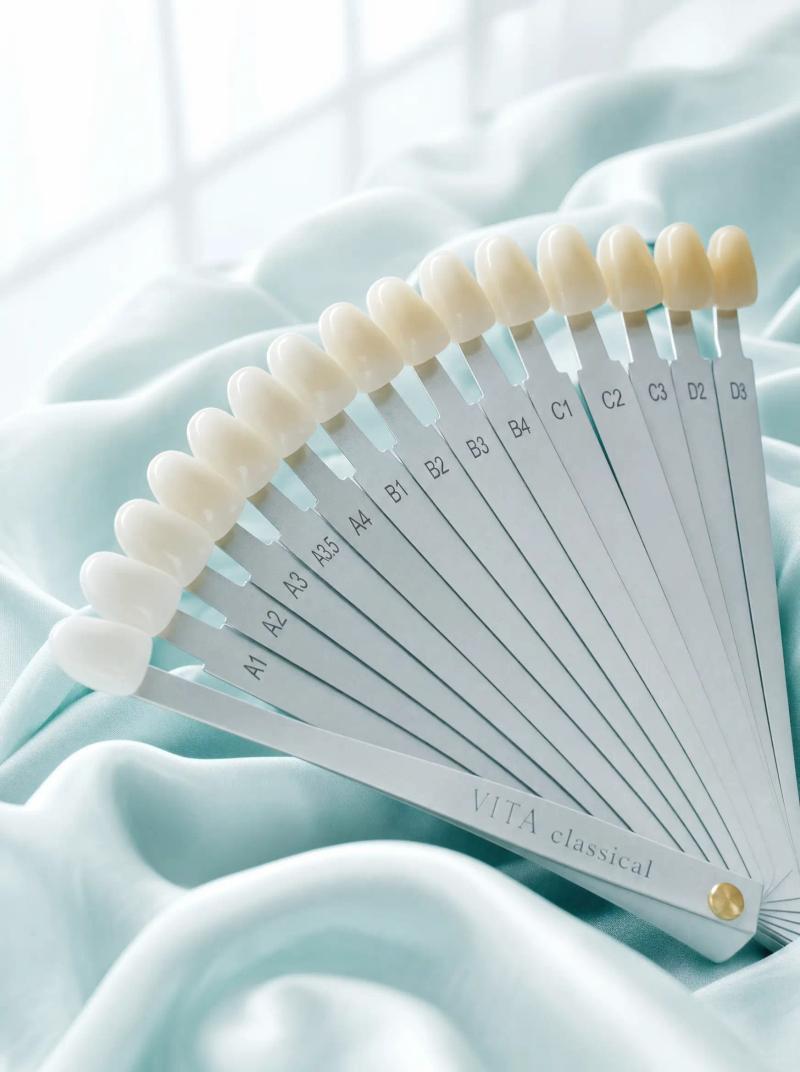
The shade is chosen from a guide held beside the teeth either side, so a treated tooth reads as part of the set rather than as a correction.
Porcelain holds its colour
Glazed porcelain does not take up coffee and tea the way composite does. It also cannot be whitened later, which is why any whitening is done first and the porcelain is matched to that result.
Shape and edge as well as colour
A worn edge, a chip or a narrow tooth can be rebuilt in porcelain. Whitening gel has no way to change any of those.
You hear the trade before it happens
What comes off, what it commits you to and what it costs are all covered before a tooth is touched. If veneers are the wrong tool for your case, that is the answer the appointment gives you.
What it costs
The number comes out of the exam.
Veneer cost turns on how many teeth are treated and what the porcelain has to correct, so there is no single figure to publish here. You get yours at the exam, in writing, before anything is prepared, and the desk checks your coverage at the same time.
If a number would settle it for you today, the published ones are a click away: whitening is $750 flat, and the exam and cleaning are $181–$301.
- Veneers
- Quoted at the exam
- Insurance
- Cosmetic work is rarely covered
- In writing
- Before any enamel is prepared
Insurance is checked before treatment either way, so you know what is left to pay before you agree to anything.
Proof
Patients, verbatim.
“Incredibly knowledgeable, friendly, and they do what they can to make your visit as comfortable as possible. The utmost professionalism no matter the situation.”
“The team was very flexible and made me feel comfortable through all procedures. It is also very affordable compared to other dentists in Ontario.”
Before you commit
Questions about veneers
How much do porcelain veneers cost?
No figure is published for veneers yet. The cost depends on how many teeth are treated and what is being corrected, and you receive it in writing at the exam before treatment is agreed.
Are veneers reversible?
No. Preparing a tooth for a porcelain veneer removes a layer of enamel, and enamel does not grow back. From then on the tooth needs a veneer or another covering, and a veneer that fails is replaced rather than removed.
Do I have to have veneers to change how my front teeth look?
No. Whitening changes colour and bonding can reshape an edge, and both leave the enamel intact. The exam compares those options against veneers for your case before anything is recommended.
Will the veneers match my other teeth?
The shade is chosen against a shade guide held beside your own teeth before the veneers are made. Porcelain cannot be whitened afterwards, so any whitening is done first and the porcelain is matched to that result.
How long do veneers last?
There is no guaranteed lifespan. Porcelain can chip or come unbonded, and how long a veneer lasts depends on your bite, your daily cleaning, and habits like grinding and nail-biting.
How many visits does it take?
More than one. The teeth are prepared and a scan or impressions taken at the first appointment; a dental laboratory makes the veneers, and they are bonded at a later visit.
Does insurance cover veneers?
Cosmetic treatment is rarely covered. The desk checks your plan and tells you what, if anything, applies before treatment begins.
Book a visit
Book the exam and hear what veneers would involve.
It covers what would come off, which alternatives would get you the same result, and the price in writing.